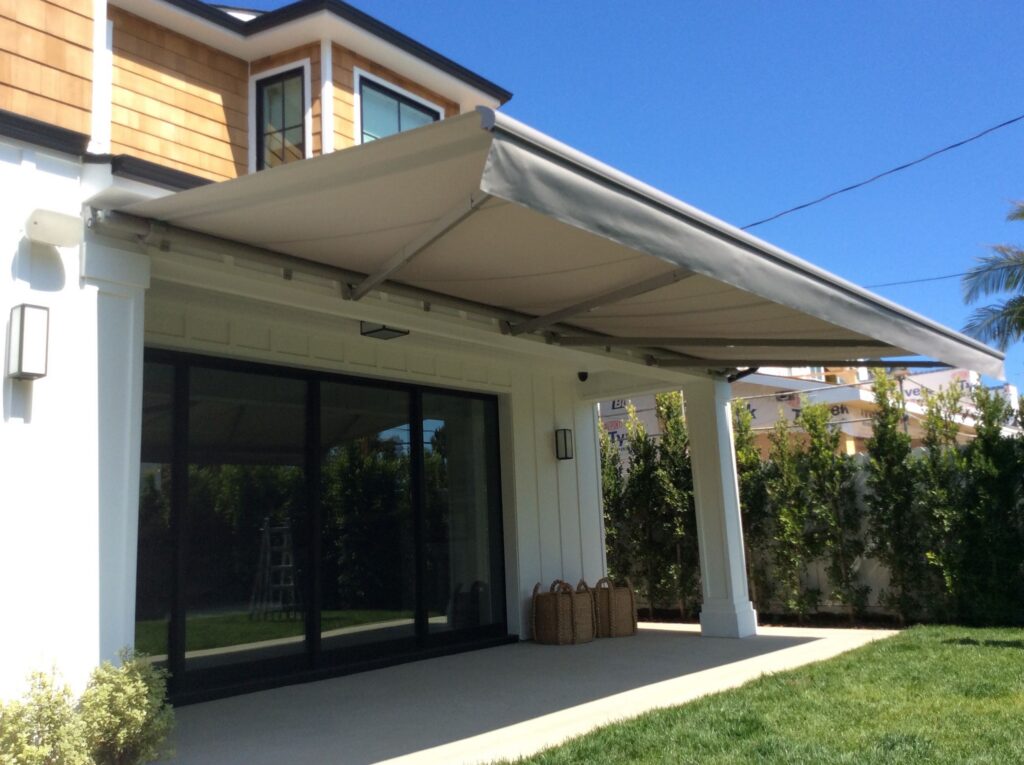

If you’re considering a retractable awning for a patio, storefront, or outdoor dining area, here’s the most useful thing we can tell you: the awning itself is the easy part. The three decisions you make before it gets built are what determine whether you love it for fifteen years or regret it in two. Here’s what you’re actually choosing.
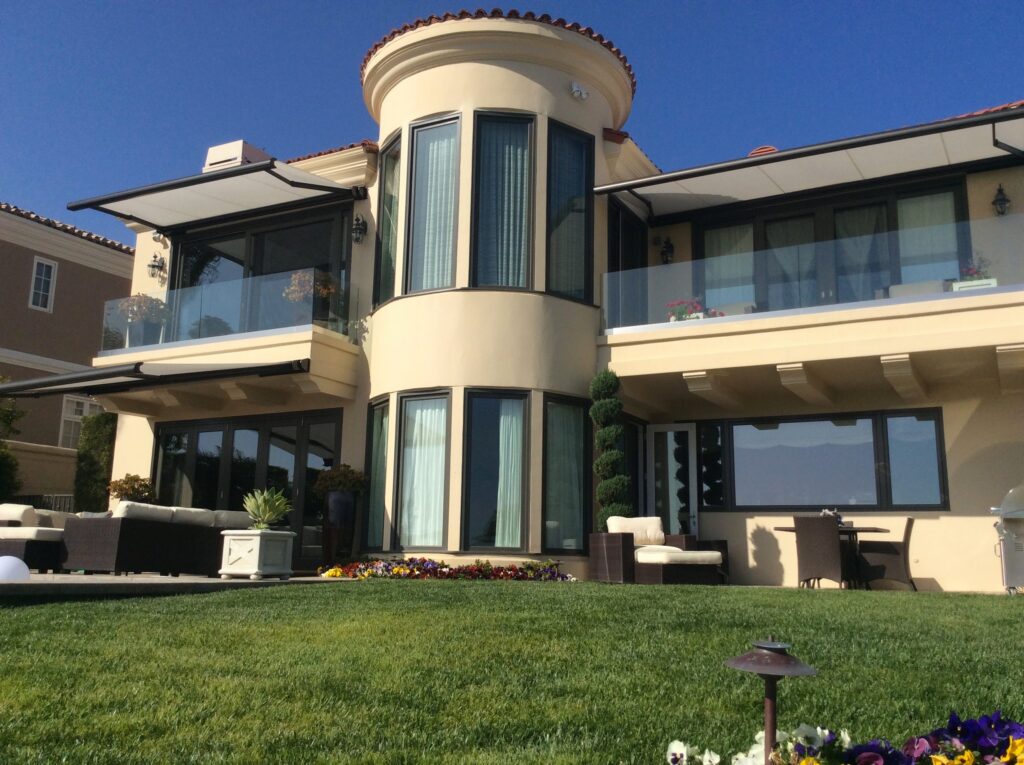
Decision one: fabric. This is the choice most people rush through and the one that matters the most day-to-day. You’re picking between three main categories, and each one trades off differently.
Solution-dyed acrylic is the most common choice for residential and light commercial. It breathes, which means the space underneath doesn’t feel like an oven. It holds color well in UV exposure. It comes in hundreds of colors and patterns. The trade-off is that it’s not fully waterproof — it sheds light rain but isn’t a rain canopy.
Vinyl-coated polyester is heavier, more durable, and genuinely waterproof. It’s the better choice for commercial patios that need to stay open during a drizzle, or for high-UV environments where longevity matters more than breathability. The trade-off is weight and airflow — the space underneath will be warmer.
Mesh blocks UV while letting air and diffused light through. It’s ideal for spaces where you want shade without feeling closed in — think poolside lounges or brewery patios. The trade-off is that it offers no rain protection at all.
Ask for fabric samples before you commit. Live with them for a few days. Hold them up to the sun. The difference between these three categories is something you’ll feel every time you sit under the awning.
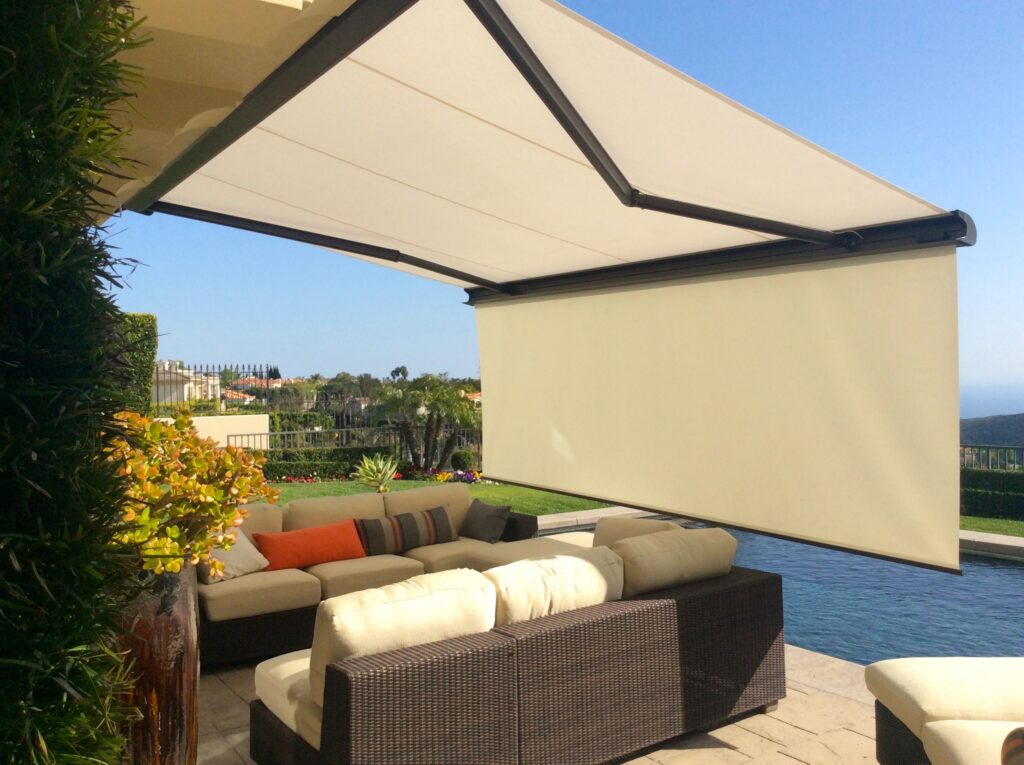
Decision two: controls. Manual crank is the simplest — turn a handle, the awning extends or retracts. It’s reliable, inexpensive, and works fine for a homeowner or a small space managed by one person. Motorized with a switch or remote is the standard for commercial applications — push a button, done. The next level is motorized with sun and wind sensors: the awning extends automatically when UV hits a threshold and retracts automatically when wind speeds get dangerous. That sensor package sounds like a luxury, but if you’re a restaurant operator who can’t have a staff member monitoring the weather all afternoon, it’s the option that protects both the awning and your customers.
Decision three: projection and mounting. How far does the awning need to extend from the building? Six feet covers a bistro table. Twelve feet covers a real dining section. Beyond that, the frame, arms, and mounting hardware all need to be engineered for the increased span and wind load. Where it mounts matters too — fascia, wall, or soffit — and each has different structural requirements depending on what’s behind the surface.
Here’s why this matters now: all three of these decisions need to be made before shop drawings can be drafted, fabric can be ordered, and fabrication can start. That’s a timeline measured in weeks. If you want shade for the peak of summer, the fabric samples, control options, and site measurements need to happen in the next few weeks — not in August when the calls start flooding in.